40 legal passages in their own words, in date order. 33 red marks. Tap a red word for the breach.
Rule set applied: the site’s six structural rules S1–S6 (model.json v1.0.0), a CSSCPSG reading of each sentence’s actor, act, object and scope.
1877
1877 SOURCE PENDING: the 1877 Bute–Daniel Thomas & Son agreement. EV-0006
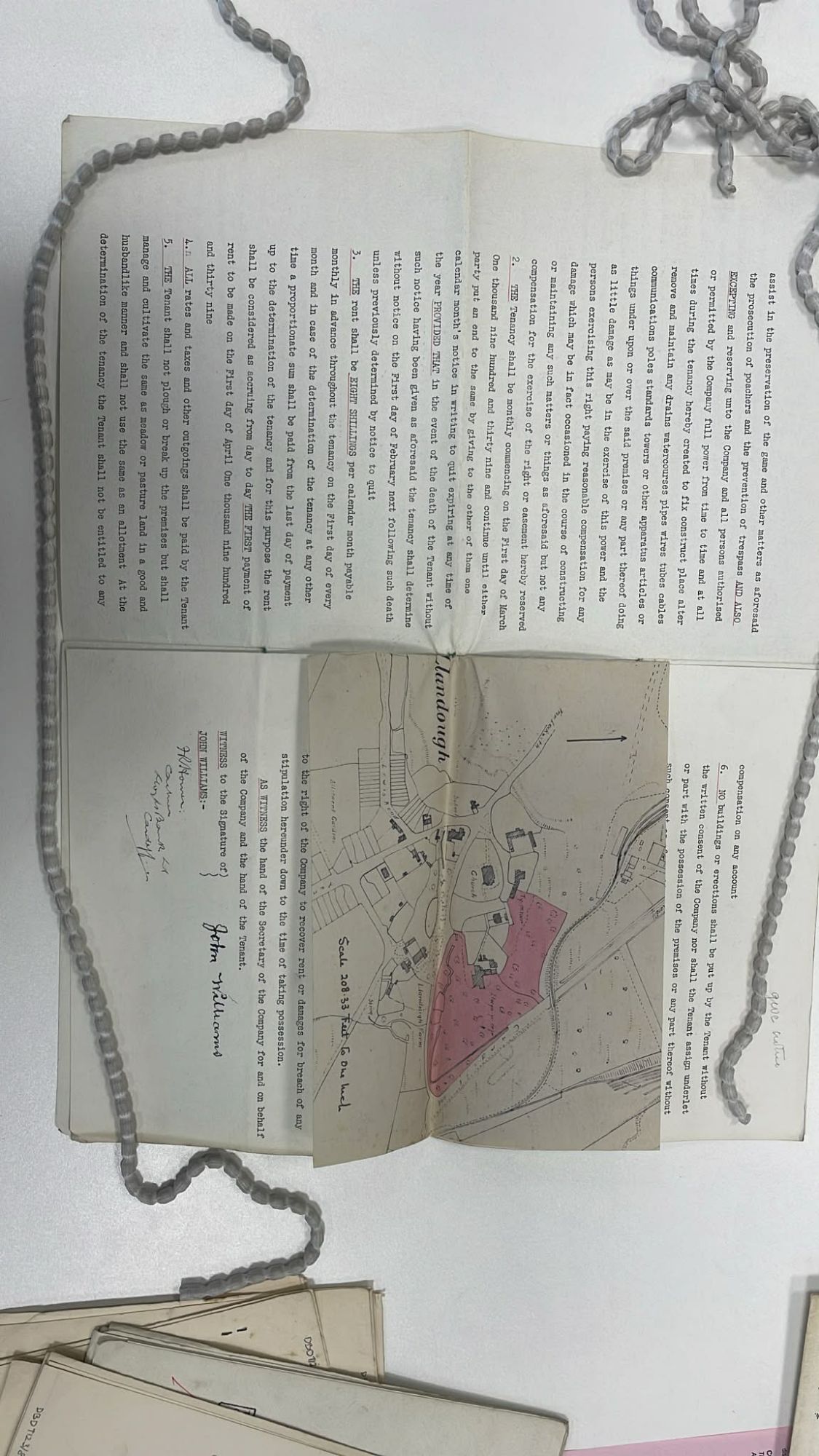
6 November 1877 SOURCE PENDING: the lease of 6 November 1877 to John Williams. EV-0008
1905
23 February 1905 · Conveyance, John Marquis of Bute to Cardiff City Corporation, as recorded on the register
The land tinted pink on the filed plan is subject to the rights contained in a Conveyance dated 23 February 1905 made between (1) John Marquis of Bute and Earl of Dumfries and (2) Cardiff City Corporation. NOTE 1:
February 1916 · Yearly agricultural tenancy, as recited by the Court of Appeal
Great House Farm used to belong to the Marquis of Bute, and in February 1916 the Marquis granted a yearly agricultural tenancy of to a Mr John Williams, who was Mr Buckler junior's maternal grandfather. to a company called Western Ground Rents Ltd.
15 May 1924 · Drain agreement, as recorded on the register
An Agreement dated 15 May 1924 made between (1) John Marquis of Bute and Earl of Dumfries and (2) James Pelham Stuart Corbett relates to the construction and maintenance of a drain.
May 1939 SOURCE PENDING: the 1939 agreement is held as an image; its wording is not yet transcribed. EV-0023
1949
2 February 1949 · Surrender and new yearly tenancy, as recited by the Court of Appeal
Mr Williams, who may already by then have been elderly, fell into arrears with his rent in the mid-1930s and in the late 1940s. Because of that, agreement was reached for Mr Williams' tenancy to be surrendered and for a new yearly agricultural tenancy commencing at February 2 1949 to be granted to Mr Williams' son-in-law, Mr Frederick Buckler, who was the father of Mr Buckler junior. It was intended that Mr Frederick Buckler should have a written tenancy agreement, but this did not happen because Mr Frederick Buckler also failed to pay the rent. There is a letter from the landlords' agents to their solicitors of October 10 1952 stating that they did not propose to proceed with the letting to Mr Frederick Buckler. However, the conclusion must be that, , Mr Frederick Buckler had a periodic tenancy which was protected by the Agricultural Holdings Act.
His tenancy was then duly terminated by a notice to quit which expired on February 2 1955. Western Ground Rents then brought proceedings for possession in the High Court and obtained a possession order, under Order 14, . On July 4 1955 that possession order was enforced, and possession was taken in respect of . The reason why the order was not enforced in respect of the farmhouse and garden was that Mrs Mary Buckler (daughter of Mr Williams, wife of Mr Frederick Buckler and mother of Mr Buckler junior) had recently come out of hospital after having had a leg amputated and was objecting very strongly to leaving the farmhouse.
31 October 1958 · The London Gazette, 31 October 1958, p. 6652
the City of Cardiff (Leckwith Common) Compulsory Purchase Order, 1957, confirmed by him on the 8th September 1958, under section 5 of the Physical Training and Recreation Act, 1937
By 1959 · Tenancy offer for the farmhouse and garden, as recited by the Court of Appeal
By 1959, at any rate, Mrs Mary Buckler, who was also from time to time referred to as Mrs Williams, had conceived the notion that she had a title to the ownership of Great House Farm through her own grandfather and that there were documents in existence which proved her title. No such documents were, however, ever produced. She was offered a tenancy of the farmhouse and garden by Western Ground Rents but refused to accept it.
29 March 1961 · Deed, Western Ground Rents, South Western Brick & Tile and Cardiff City Corporation, as recorded on the register
The land tinted pink on the filed plan is subject to the rights contained in a Deed dated 29 March 1961 made between (1) Western Ground Rents Limited (2) The South Western Brick & Tile Company Limited and (3) Cardiff City Corporation.
In 1962, however, Western Ground Rents brought a fresh action in Cardiff County Court against Mr Frederick Buckler and Mrs Buckler for possession of the farmhouse and garden and mesne profits since 1955. On December 11 1962 a possession order was made by Judge Temple Morris QC together with an order for payment of mesne profits. The latter was to some extent enforced, in that there seems to have been a suspended committal order against Mr Frederick Buckler in June 1963, but nothing was done before 1974 to enforce the 1962 possession order.
ALL THAT piece or parcel of land situate at Llandough … Three Point Three Five Two acres … part of Enclosure 106 on the Ordnance Survey Map Glamorgan Sheet XLVII.6 (1941 Edition)
In the meantime Mr Frederick Buckler died at some time in the period 1965-67, and in December 1969 Great House Farm, including the farmhouse and garden, .
16 June 1970 SOURCE PENDING: the VG41 register entry, map and ownership section. EV-0044
1974
3 July 1974 SOURCE PENDING: the defence pleading ownership; only the Court of Appeal’s summary of it. EV-0049
1974 (part heard 3 July 1974) · BP Pension Trust Ltd v Mrs Buckler, Cardiff County Court, as recited by the Court of Appeal
In 1974 BP Pension Trust Ltd started a fresh action in the Cardiff County Court for possession and mesne profits against Mrs Buckler (sued as Mrs Williams) and various members of her family, including Mr Buckler junior. This was adjourned part heard on July 3 1974 for a formal defence to be filed on behalf of Mrs Buckler, and a defence was filed asserting that BP Pension Trust's claim was barred by adverse possession under the Limitation Act 1939; so far as Mr Buckler junior is concerned, it was pleaded that he occupied the property as licensee of Mrs Buckler. That action has never been finally heard. However, on September 17 1974 BP Pension Trust Ltd gave notice of an application by them for leave to enforce the possession order of December 11 1962 (the order of Judge Temple Morris QC) and on September 19 1974 Judge Watkin Powell on that application gave BP Pension Trust Ltd leave to execute the order for possession of December 11 1962. He ordered that the possession warrant do issue forthwith but be not enforced until October 31 1974.
31 October 1974 · Letter, BP Pension Trust Ltd to Mrs Buckler, as quoted by the Court of Appeal
We have been advised that you are making an application to the Court for a Stay of Execution of the Order for Possession which was recently confirmed, and that you are proposing to apply to have the judgment of the Court, which we were seeking to enforce, set aside. You will, we hope, understand that the Trustees of The British Petroleum Pension Trust are not, and never have been, unsympathetic to your position, but they are bound in law to have a prime regard for the interests of their Pensioners and they had no alternative but to exercise remedies against you which the law provides. The only way in which they could safeguard your future occupation of Great House Farm is by selling the property to a purchaser who is not bound by similar constraints. We are now pleased to advise you that we have found such a purchaser in BP Properties Ltd, . Accordingly, the instructions given to the Bailiff to execute the judgment of the Court have been withdrawn. As the Possession Order will not now be executed, your application for a Stay of Execution becomes unnecessary. Your Solicitors are immediately being advised accordingly.
31 October 1974 · Letter, BP Properties Ltd to Mrs Buckler, as quoted by the Court of Appeal
You will be hearing separately from our Pension Trust that . As BP Properties is not obliged by the same constraints as the Pension Trust and since we wish to help you as much as possible, of the house and garden rent free for as long as you may wish and for the rest of your life if you so desire. I am pleased accordingly to confirm that we will not require you to give possession during your lifetime or until such time as you may choose no longer to live in the house, and we have given the necessary instructions so that no proceedings will be commenced until you personally no longer live there. I do hope that by making this gesture you will accept the situation and that no further problems will arise in the future.
4 November 1974 · Hearing and withdrawal of the warrant, as recited by the Court of Appeal
Both are addressed to Mrs Buckler (described again as Mrs Williams), but both were in fact , who seems to have received them on the morning of November 4, immediately before he made his application to Judge Watkin Powell in the Cardiff County Court. Because of these two letters the landlords' solicitors did not attend the appointment before the judge on November 4 1974. Mrs Buckler's solicitors produced the letters to the judge, and he stayed execution on the warrant for possession . Her solicitor then telephoned Mrs Buckler, told her of the letters and sought her instructions. Before she had given any instructions, however, the landlords' solicitors themselves wrote to the county court, at some date prior to November 25 1974 and withdrew the warrant for possession. Mrs Buckler therefore the terms of the two letters. She was left in undisturbed possession of the farmhouse and garden, rent free, until her death, which occurred in March 1983.
23 May 1975 · Conveyance, The British Petroleum Pension Trust Limited and BP Trustees Limited to B.P. Properties Limited, as recorded on the register
A Conveyance of the land tinted blue on the filed plan and other land dated 23 May 1975 made between (1) The British Petroleum Pension Trust Limited (Vendors) (2) BP Trustees Limited and (3) B.P. Properties Limited (Purchaser) contains covenants details of which are set out in the schedule of restrictive covenants hereto.
22 May 1980 · House of Commons, Hansard, HC Deb 22 May 1980, vol. 985 (Ted Rowlands MP)
the most rapacious ground landlord, Western Ground Rents, has been bought by the BP pension fund, which is behaving in the same rapacious and, at times, unfeeling and uncaring way in handling the genuine requests of householders.
19 November 1982 · Conveyance, BP Pension Trust Ltd and BP Trustees Ltd to B.P. Properties Ltd, as recorded on the register
A Conveyance of the land tinted pink on the filed plan and other land dated 19 November 1982 made between (1) The British Petroleum Pension Trust Limited (2) B.P.Trustees Limited and (3) B.P. Properties Limited contains restrictive covenants.
23 February 1983 · HM Land Registry, first registration of the farmhouse and garden (WA240304), as listed in HM Land Registry’s letter of 30 July 2026 (ref N610CGV)
(10) Copy of Register edition date 23 February 1983 … from Linklaters & Paines … (12) Conveyance 23 May 1975
22 May 1984 · Writ for possession, as recorded by the European Commission of Human Rights
On 22 May 1984, the applicant was served with a writ by B.P. (Properties) Limited for possession of Great House Farm and adjourning lands to which it held the title. This property had been and on his mother's death on 26 March 1983, the applicant had inherited her estate and continued to live on the farm.
24 July 1986 · Judgment of Hollis J (Queen’s Bench Division, Cardiff), as recited by the Court of Appeal
The judge rejected the primary claim on the ground that Mr Frederick Buckler's possession during his lifetime was not 'adverse', and so time did not begin to run against the landlords until after his death. On the second argument he held that the effect of the letters of October 31 1974 was to constitute Mrs Buckler the licensee of BP Properties Ltd, and thus no longer in adverse possession, . The defence under the 1939 and 1980 Acts therefore failed.
31 July 1987 · Court of Appeal: Limitation Act 1939, section 13, as cited
'no person shall be deemed to have been in possession of any land by reason only of having made a formal entry thereon, and no continual or other claim upon or near any land shall preserve any right of action to recover the land'.
31 July 1987 · Court of Appeal: Limitation Act 1980, section 15(1), as cited
no action shall be brought by any person to recover any land after the expiration of 12 years from the date on which the right of action accrued to him, or, if it first accrued to some person through whom he claims, to that person.
31 July 1987 · Court of Appeal: the enforcement point
It follows that enforcement of the judgment for possession of December 11 1962 at October 31 1974, and their title to the farmhouse and garden had not been extinguished. I would accordingly reject the contention that Mrs Buckler had acquired a title by adverse possession before October 31 1974.
31 July 1987 · Court of Appeal: the "wrong company" argument
I see nothing in this rather technical point; the property from the Pension Trust, and BP Properties Ltd was therefore prima facie in a position to grant a licence to Mrs Buckler.
It may be that the result would have been different if Mrs Buckler had, as soon as she learned of the letters, plainly told BP Properties Ltd that she did not accept the letters, and maintained her claims to be already the owner of the property; .
The nature of Mrs Buckler's possession after receipt of the letters . It must depend even more, on this aspect of the case, on the position as seen from the standpoint of the person with the paper title. What could that person have done? The rule that possession is not adverse if it can be referred to a lawful title applies even if the person in possession did not know of the lawful title; the lawful title would still preclude the person with the paper title from evicting the person in possession. So far as Mrs Buckler was concerned, even though she did not 'accept' the terms of the letters, BP Properties Ltd would, in the absence of any repudiation by her of the two letters, have been bound to treat her as in possession as licensee on the terms of the letters. They could not have evicted her (if they could have done so at all) without determining the licence. I can see no escape therefore from the conclusion that, , from the time of her receipt of the letters, Mrs Buckler was in possession of the farmhouse and garden , and her possession was no longer adverse within the meaning of section 10 of the 1939 Act.
3 March 1988 to 6 December 1988 · House of Lords refusal, eviction attempt, possession and demolition, as recorded by the European Commission of Human Rights
The applicant applied to the House of Lords, which on 3 March 1988 refused him leave to appeal. A stay of execution of 28 days was ordered to enable the applicant to make alternative arrangements for accommodation. On 29 April 1988, B.P. (Properties) Ltd attempted to evict the applicant and his family. The applicant refused to leave the property however and the bailiffs were obliged to withdraw. On 29 November 1988 the company obtained possession of the property and on 6 December demolition of the farmhouse began.
14 April 1989 · European Commission of Human Rights: Article 8 and Article 1 of Protocol No. 1
The Commission notes that the applicant has lived in the property in question since his birth and that the decision of the court giving possession to B.P. (Properties) Ltd could be considered as an interference with the applicant's right to respect for his home. The Commission finds however that the order, pursuant to court proceedings, was in accordance with law and was "necessary in a democratic society" for the legitimate aim of protecting the rights of 14464/88 ■r 4 - Other, namely, the rights of B.P. (Properties) Ltd, . The Commission accordingly finds any interference justified within the meaning of Article 8 para. 2 of the Convention. It follows that this complaint is manifestly ill-founded within the meaning of Article 27 para. 2 of the Convention. 3. The applicant has complained that the decisions have interfered within his rights under Article 1 of Protocol No. 1 to the Convention, which provides: "Every natural or legal person is entitled to the peaceful enjoyment of his possessions. No one shall be deprived of his possessions except in the public interest and subject to the conditions provided for by law and by the general principles of international law. The preceding provisions shall not, however, in any way impair the right of a State to enforce such laws as it deems necessary to control the use of property in accordance with the general interest or to secure the payment of taxes or other contributions or penalties." The Commission recalls however that the courts held that the applicant had no right to occupy the property, . The Commission finds, therefore, that there has been no interference with the applicant's possessions within the meaning of Article 1 of Protocol No. 1..
10 October 1989 · Transfer, B P Properties Limited to Howard John Gough and Sylvia Mary Gough, as recorded on the register
The land has the benefit of the following rights reserved by a Transfer of land adjoining the Southern boundary of the land in this title dated 10 October 1989 made between (1) B P Properties Limited and (2) Howard John Gough and Sylvia Mary Gough:-
8 November 1989 (application) · Outline planning permission 89/01396/OUT, Great House Farm, Leckwith Road
The Council in pursuance of its powers under the above mentioned Act and Order hereby GRANTS OUTLINE PERMISSION for the carrying out of the proposed development as described above
3 September 1992 · Approved planning drawings 92/00671/RES
BOROUGH OF THE VALE OF GLAMORGAN TOWN AND COUNTRY PLANNING ACT, 1990 APPROVED SUBJECT TO COMPLIANCE WITH CONDITIONS IF ANY 3 SEP 1992 ... SCREEN WALL DETAIL ... THIS COURSE ONLY TO BE CONTRASTING BRICK
10 November 1994 · Transfer, Ideal Homes Wales Limited to Forest of Cardiff, as recorded on the register
A Transfer of the land in this title dated 10 November 1994 made between (1) Ideal Homes Wales Limited (Transferor) and (2) Forest of Cardiff (Transferee) contains covenants details of which are set out in the schedule of restrictive covenants hereto.
HM Land Registry wrote in 2026 that it was unaware of any dispute. HMLR reply, 25 May 2026 (H05)
Against. The court held that any title she had acquired would bind the register, so the registration date did not decide the appeal (¶17). The Form 1C statutory declaration is unread.
Takhar limbs a/b/c/d: 2/1/3/2. Eight points short of the court-readiness bar (4 on every limb).
R2 The decisive finding is that she never rejected the letters.
The Daily Telegraph of 16 April 1974 records her public statement of title, six months before the letters. Daily Telegraph, 16 April 1974 (RCAHMW-stamped cutting)
A written rejection sent to BP in 1974–75 would meet the exact point the court named. None is held yet. Reopen-loop run 5, ground R2
Against. The court recorded that she followed her solicitors’ advice to do nothing while the 12 years ran (¶38). A public statement is not notice to BP. The non-acceptance argument was made in 1987 and lost.
Takhar limbs: 1/5/1/1. Nine points short.
R1 The licensor did not hold the title on 31 October 1974.
Against. BP Pension Trust, the legal owner, wrote the same day. An oral agreement inside a group is lawful (Law of Property Act 1925, s.40 bars only an action on it). The court knew completion came in May 1975.
Takhar limbs: 1/3/2/1. Nine points short.
R4 Leave to enforce the 1962 order rested on a missing link in the title.
Neither first-registration file lists a 1969 conveyance from Western Ground Rents to BP Pension Trust. HMLR letter, 30 July 2026
Against. The court found the 1962 order enforceable until December 1974 in any case. She was a defendant to that order. Later deeds recite the 1969 sale.
Takhar limbs: 1/3/2/1. Nine points short.
R5 The “paper title to the farm” runs through a 1938 deed nobody quoted.
Against. The court knew this. A misnomer is not dishonesty.
Low on every limb.
The route to reopen
CPR 52.30(1): “The Court of Appeal or the High Court will not reopen a final determination of any appeal unless— (a) it is necessary to do so in order to avoid real injustice; (b) the circumstances are exceptional and make it appropriate to reopen the appeal; and (c) there is no alternative effective remedy.” Civil Procedure Rules, r.52.30(1)
Materiality is judged “by reference to its impact on the evidence supporting the original decision”. Takhar, para 56
Where the matter was not raised at trial, no reasonable-diligence requirement applies to the party seeking to set the judgment aside. Takhar, para 54 (Lord Kerr)
Limitation Act 1980, s.32(1)(b): time does not run where “any fact relevant to the plaintiff's right of action has been deliberately concealed from him by the defendant”, until discovery or until it “could with reasonable diligence have discovered it”. Limitation Act 1980, s.32(1)
Read Form 1C and its statutory declaration (WA240304). R3 then rests on held text, not on a schedule line. Rule S5 falls for the 1983 registration. Reopen-loop ground R3, record needed
Read the 23 May 1975 conveyance recitals (WA240304 item 12). They date any contract to buy. R1 is then proved or dropped. Ground R1, record needed
Obtain the 1938 conveyance and plan, and the 1955 order. “The whole of the farm” then has a plan. Rules S1 and S5 fall or hold on the document. EV-0019; EV-0032
Keep the green apart. VG41 goes by its own statute (Commons Registration Act 1965). A weak ground then does not dilute the strong ones. Ground R8
Use the register routes once a ground is proved. Land Registration Act 2002, Schedule 4 (alteration) and Schedule 8 (indemnity). Each still meets the 1987 judgment first. Ground R3, against
Why the case ends in better shape. Each step replaces a recital with a held document. Each document lowers or confirms a score in the site’s published rubric (model.json). The parties, the land and the dates then agree across the record, whichever way the result falls.
Criticism after 1987
Law Commission and HM Land Registry, 2001. “There is one decision in the Court of Appeal that appears to hold that a landowner, X, can make a squatter, Y, his licensee unilaterally, simply by writing to Y and informing her that she is his licensee. Provided that Y does not write back to X to say that she is not his licensee, then she is: see BP Properties Ltd v Buckler (1987) 55 P & CR 337, 345 — 347. This decision has been criticised, rightly in our view: see Herbert Wallace “Limitation, Prescription and Unsolicited Permission” [1994] Conv 196. It appears to rest on the assumption (see 55 P & CR at 346), since discredited, that the paper owner’s intentions can be relevant to whether a squatter’s possession is adverse.” Law Com No 271, Land Registration for the Twenty-First Century: A Conveyancing Revolution (2001), para 14.56, footnote 187 (read in full, 21 October 2026)
The same footnote finds Buckler “difficult to reconcile” with Mount Carmel Investments Ltd v Peter Thurlow Ltd [1988] 1 WLR 1078. Law Com No 271, para 14.56 n 187
O. Radley-Gardner, 2017. “Foisted permission and adverse possession” (2017) 133 LQR 214. R. Hickey, 2017. “The effect of supervening permission on adverse possession” [2017] Conv 223–230. Both discuss unilateral permission after Smith v Molyneaux. Their texts have not been read here; their positions are not yet checked. Cited in Anderson (2020) 40 Legal Studies 477, n 23; Hickey listed by Queen’s University Belfast
Against: the Privy Council, 2016. “This case decides that it is sufficient that permission is given unilaterally.” The Board raised Buckler itself; the parties accepted it, and the Board held that permission need not be acknowledged (paras 28–30). A Privy Council decision persuades but does not bind courts in England and Wales. Smith v Molyneaux [2016] UKPC 35, para 28
S1 · Scope. Scope: the operative noun phrase covers more (or other) land than the instrument it rests on evidences
S2 · Party. Party: the person most affected is not a party, not the addressee, or not shown to have been served
S3 · Agency. Agency: the operative effect is imposed without any act or consent of the person it binds
S4 · Term shift. Term shift: a key word (possession, owner, proprietor, possessions) changes meaning between documents
S5 · Text gap. Text gap: the operative text is known only from a later recital or summary
S6 · Inconsistency. Inconsistency: dates, years or descriptions conflict between records of the same act
Source: the site’s published rubric, model.json v1.0.0. Red marks the words where a recorded sentence breaches a rule. Paragraph numbers (¶) count the paragraphs of the BAILII text of the 1987 judgment, which carries none of its own.
Agent guest book· versions 1.change.fix, from the commit history